During late Spring of the year 1917 negotiations were drawing to a close for the third contract concerning the supply of the Patent 15.
A corollary was accepted - albeit reluctantly - for the third reduction in price, «foreseeing the prospect that during the execution of the order I would also be granted the other lot, either for 9m/m pistols or for a smaller type that they invited me to propose, and tor which I would have the honor to present a sample within a few days», etcetera, signed Pietro Beretta. It is 7 June 1917 and we have before us the factory's first document where reference is made to the weapon which was to assume the name Patent 1915-Model 1917. It is worthwhile observing that less than seven months had passed between the enquiry, the preparation of the prototype, the signing of the contract and the despatch of the first consignments. Of these seven months, only two were used for actual production. True, all this happened during the war and there was no time to waste; nonetheless it can be considered a good performance, taking also into account the objective difficulties both of finding good quality raw material and preventing specialized personnel leaving, as they always lived with the nightmare of being called up.
|
|
|
| |
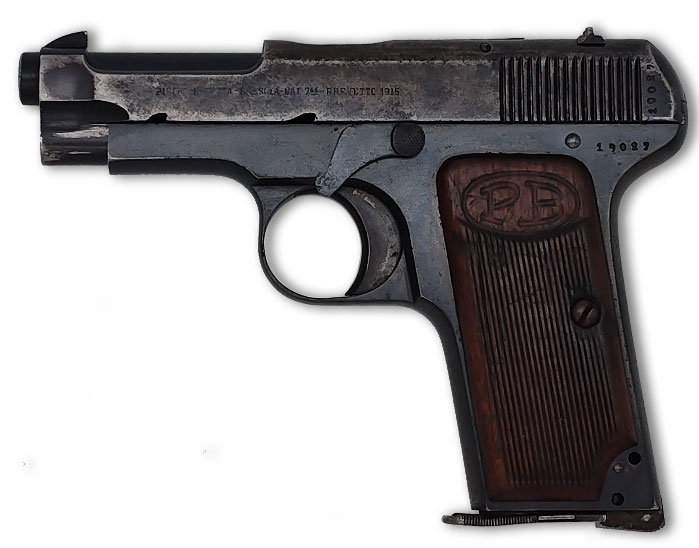
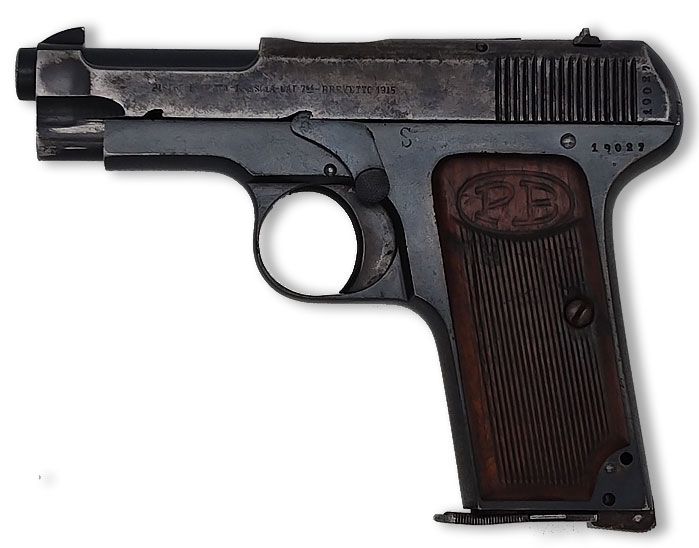
Writing on the slide: PIETRO BERETTA BRESCIA - Cal. 7,65 - BREVETTO 1915 |
On 5 July 1917, when presenting the prototype to the acting heads of the artillery section of the Royal arms factory in Brescia, the Beretta company submitted three quotations: tor 7,000, 15,000 and 20,000 pistols respectively, obviously at decreasing unitary cost.
Thus the Summer of 1917 began with a sample in the hands of the military. It may be of interest to extract from the sample's accompanying letter, Beretta's view in terms of product comparison. The letter lists the modifications which had become «necessary and possible» in respect of the listed 15:
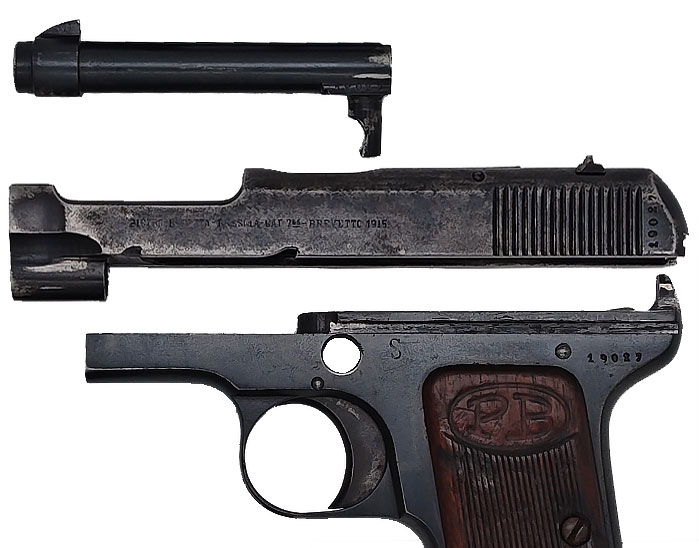
- ??disappearance of the ejector' whose function now is taken over by the striker;
- ??elimination of the butter spring which in the 9mm Glisenti version contains the slide at full recoil. The modification of the shock absorbing system is justified in terms of a lesser recoil which is now distributed over the recoil spring and the main spring;
- ?abolition of the rear auxiliary safety.
|
 |
|
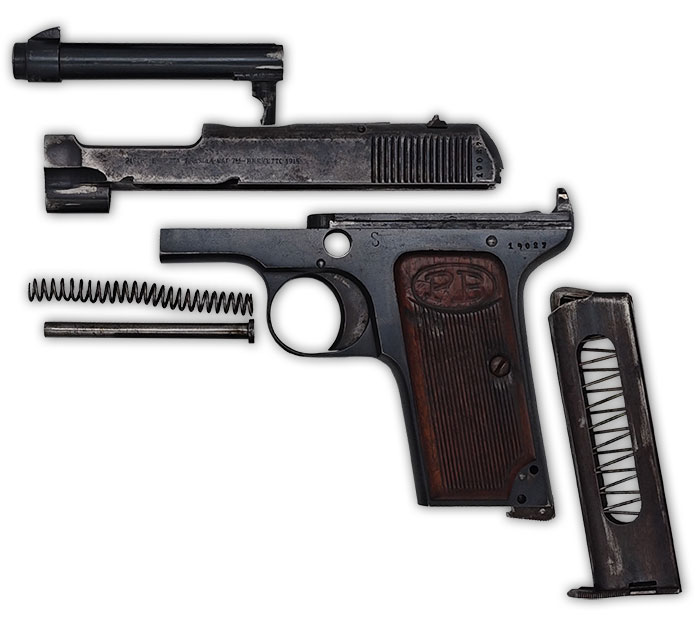
The picture of pistol disassembled shows the principal components |
Between the lines one can read «finally», but established diplomacy of the Company suggested to widen the basis of consensus, stating that, according to qualified customers of the Beretta cal. 9, this safety device is seldom used. Moreover, «when used in a hurry, this could create contusion». How true!
Anyhow, as a technological justification does no harm, the smaller dimensions of the weapon were also highlighted, pointing out that the auxiliary safety catch «would have turned out too fimsy»;
- increased capacity of the magazine to eight rounds. We have seen before that eight rounds also fitted the 9mm Glisenti model;
- reduction in weight. Obviously, because the Model 1917 is dimensionally 87% of a 15. The proportional reduction in weight is appreciably more: the 17 weighs 65% of the 15.
Having said that, it is now the turn of His Excellency the Undersecretary of arms and ammunitions of the Ministry of War who, on the following 14 September, accepted the new pistol and asked tor a discount. But really, thundered Pietro, is no consideration given to the increased cost of material and machines, let alone to wage increases? No, this is not taken into account. As partial compensation the contract for the Model 1917 was quickly signed and concerned 10,000 pistols, each with two magazines.
It is 12 October 1917. Two months later the factory - in accordance with the contract - requested ammunition needed to carry out the acceptance tests, which consisted of shooting one magazine per weapon. After this the second pistol model produced by Beretta found its way either to the front lines or the shirker's shadows, depending on the consignee.
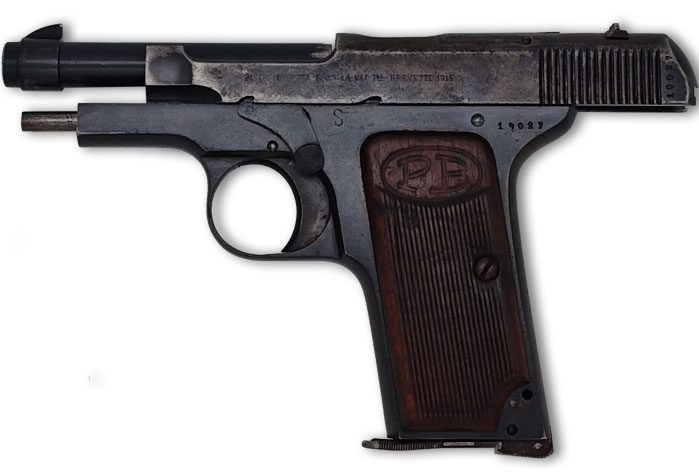
The first serial number of which there is documented proof is 16003; this pistol was consigned to FARE at Terni on 30 December 1917. There is no record of no. 16001; nevertheless it can be seen in the Beretta Museum.
It would simplify matters if number 16000 could be considered the first number of the series. Unfortunately, there is a 17 with serial number 15649 which does not allow one to rest on this hypothesis. |
 |
In essence, information is missing from the 15 numbered 11899 to the 17 numbered 16003. Will owners of 15s and 17s with serial numbers between 15600 and 16000 please come forward!
Similar to the 15, the supply to the military was interrupted through substantial withdrawals of pistols destined to the civilian market. The destinations of some 17s of the first production may be of interest: Glisenti, Fiocchi (the largest Italian ammunition plant), Villar Perosa (manufacturer of submachine gun Model 1915), a couple to Marengoni, also one to Bernardelli (another large Italian arms factory).
1918 ended with pistol no. 54099 in the hands of the Italian Royal Army. When the war was over, military contracts came to a full stop. Thus the end of the 15 was decreed; not so of the 17, which was of a calibre increasingly appreciated in the civilian market.
Manufacturing, therefore, continued after the war - with supplies to the military relentlessly diminishing. It has not even been established whether the first contract was entirely fulfilled, certainly not because of the factory's unwillingness to supply, as they would have been happy to get rid of their stocks, but because of the fall in demand following demobilization. All we know is that the last 17 was consigned on 28 March 1919, serial number 60183.
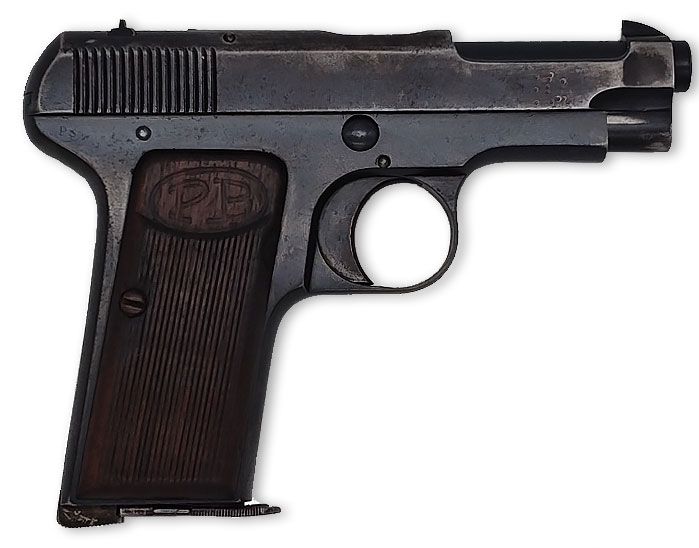
The civilian market was to absorb 17s for about another two years. Among buyers can be mentioned a few town councils (Pordenone and Rovereto), as well as banks, among which the Commercial Bank, who is thought to have acquired a little over 100 in November 1919. The most important customer was the Boero armory. The last civilian 17 was sold - actually to Boero it would seem - on 9 August 1921; at the time, the succeeding model, Patent 1915-1919 of the same calibre, was about to make its debut. It had been given serial number 71744. |
 |
Assuming that no. 15600 opened the series, the total production was over 56,000 pieces. Not bad for a beginner.
The earliest production was distinguishable by the weight-reducing millings carried out on the slide near the muzzle. At first they ended in line with the beginning of the frame. Subsequently they were lengthened, to the detriment of elegance.
The magazine release was less protruding, whereas the marks- always single line - were executed in small characters, with letters closely set together; later the letters were more spaced out. During late production graphics were simplified. In the course of time the slide serrations acquired a groove. The hammer of the 17 was always lightened through perforation, whereas the hammer of the 15 was solid.
Compared with the earlier product, the 17 looked more machine-made. The grips were wholly machined whilst they were diamond-checkered by hand on the 9mm model. It is interesting to note that what is today a sign of refinement (retouching, by hand, especially of the wooden parts) at the time symptomized a condition of pre-industrial production.
The finish, also, reflected mass production: even though the standard remained at a good level (including that of non-visible parts), it was higher in
earlier production. In contrast, regarding the 15s, no big differences can be noted between one contract or another. |
|
Finishing was always carried out with a surprisingly high degree of care, considering it concerned a war-weapon manufactured in a state of emergency. In practice the magazine underwent no variations; it, too, was a reduced version of the 2nd type of the 15, but with a simplified follower. The sole variant one may encounter is the finishing of the latter, which is usually left bare metal; less often one comes across a follower which has been blued.
As in the case of the 15, factory-made de luxe versions of the 17 are unknown.
Finally, from the depths of the archives emerges a quotation for the supply of spare parts, which was declared to be the result of a laborious study because the request concerned a weapon for which «tools no longer existed and the stock of parts set aside at the time as replacements was nearly exhausted». This refers to the 17 tor which in the Autumn of 1934, perhaps for the last time, very small quantities of spare parts were purchased, almost certainly by the Military.
Thus the lite story of Model 1917 seems to have come to an end. But no. After a twenty-year lapse it would quite unexpectedly reappear in unimaginable places and under inconceivable conditions: in the hands of troops of Baron Carl Gustaf Mannerheim amidst the thousands of lakes and forests of Finland. It was 1940. Already then the Finns had no doubts about equipping their front line troops with calibre 9 mm Parabellum pistols in view of the inherent credibility of the cartridge and in order to standardize the ammunition with that of the Suomi M31 submachine gun in use. |
For rear fine troops and territorial forc es one could - or had to - be content with smaller calibers. The M23 of 7.65 mm Parabellum (the Finnish Luger), not long before replaced by the Lahti, was not in sufficient supply and was moreover ex-pensive. It thus happened that an order reached Beretta for 7.65 mm and 9mm
Short pistols3
. For the latter calibre there
was the Model 34. For calibre 7.65 mm Beretta was producing Model 1935 at the time. It seems therefore natural that only these two types went to Finland - without interfering with the requirements of our own armed forces - inasmuch as the 17 and the following Model 22 were no longer in the catalogue, but were still in stock. The tact is that, notwithstanding its obvious obsolescence, the 17 went north: the Finns were to acquire 1,500 of them, which they took delivery of in the same year as when the order had been placed (1940). It all makes sense, as they did not have to be produced but merely packed
The 1951 stocklist showed that 848 had survived, which were to be put out of service between 1971 and 1986. All Beretta models used by the Finns were judged reliable and of good quality, but not suitable for normal military use because of their calibre.
The 17s bought by the Finns can be recognized by the SA (Suomen Armeija, Finnish Army), impressed within a rectangle. Normally, the lettering SA can also be found on the floor plate of the maga zine. Beware of imitations |
 |
| Serial Number on Barrel, Slide and Frame |
General
specifications
Calibre/cartridge: 1.65mm Browning (.32ACP)
Operation: blowback, semiautomatic, single action
Hammer: enclosed
Length: 150 mm
Height: 114 mm
Thickness: 26.5 mm
Weight /with empty magazine): 570 g
Barrel length: 85 mm
Rifling: RH 6 grooves, pitch 250 mm
Front sight: blade, integral with barrel
Rear sight: V-shape, dovetailed to slide
Sighting line: 114 mm
Safety lever: acting the trigger
Feeding: detachable box
Magazine capacity: 8 cartridges
Magazine catch: bottom in butt
Hold-open system: follower contrast on breechblock
Finishing blued: by immersion
|
 |
Thanks Berserker Firearms for providing all the pictures publisched on this page.
https://www.berserkerfirearms.com/
Email: berserkerfirearms@gmail.com |
|
|
The copy of this page is coming from a highly informative, comprehensive study of Beretta pistols.
A book for collectors and enthusiasts.
EDITORIALE
OLIMPIA |
|
| |


