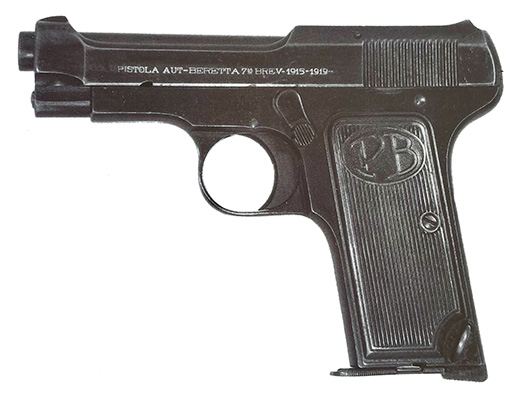
The first Beretta Model with OPEN SLIDE Less than a year after Patent 1919 Mod el 1920 calibre 6.35mm had been put on the market about 17,000 pistols had been manufactured by 31 December 1920) Beretta began production of Model 1922. The first pistol of this type entered Beretta's Brescia warehouse on 21 February 1921. In the official catalogues of that time the pistol was described as Model 1922. Probably, despite the fact that manufacturing had begun ten months earlier, Beretta wanted to announce that he had definitely started to market this new weapon. In order to obtain sole rights for the new system of fixing the barrel to the frame, patent no. 172.302 of 10 February 1919 applied to Model 1922 as it had done to pistols of previous Model 6.35 mm. Also for this weapon the new type of safety catch was accepted, as was the new shape of the slide, characterised by a large opening that left open almost all of the upper surface of the slide, thus eliminating the narrow ejection port.
|
|
||
One of the very first 1917 Pistol Writing on the slide: PISTOLA AUT- BERETTA 7,65 - BREVETTO 1915-1919 |
|||
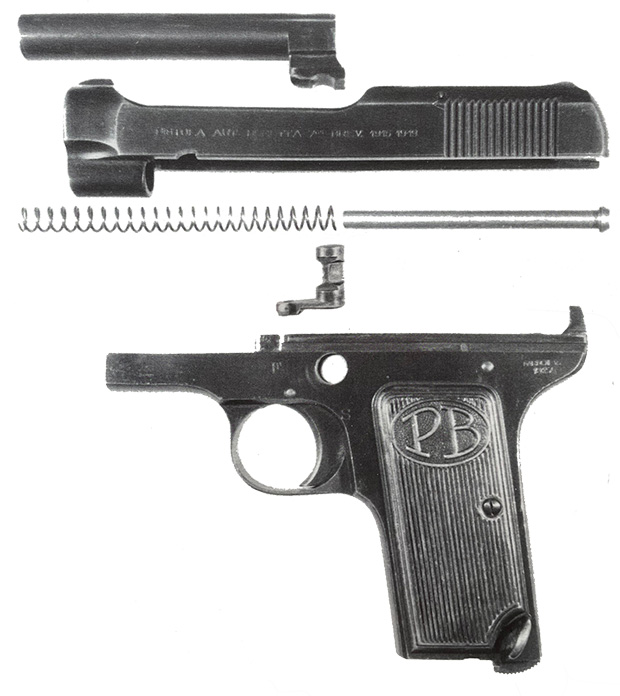
To ensure sturdiness the slide was however closed in front where the sight was fitted. This solution, which was necessary for disassembling the barrel and which remained unaltered until the most recent Beretta models), had the positive characteristic of appreciably reducing the risk of jamming on account of faulty ejection of cartridge cases.
|
 |
||
|
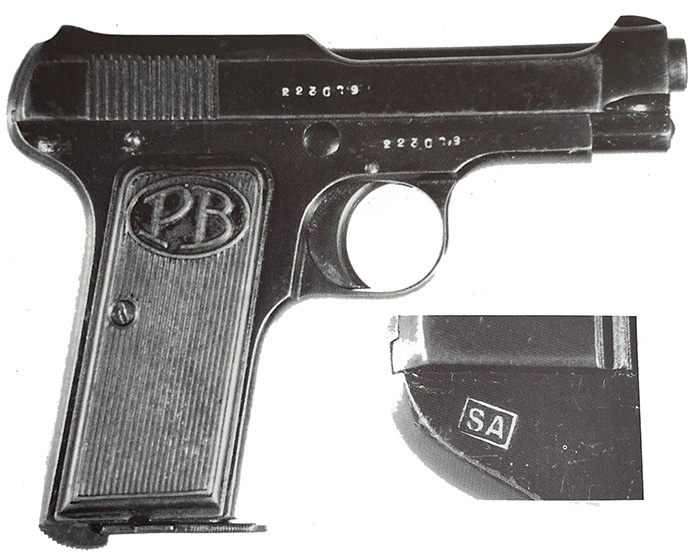
The Italian Royal Air Force, which had been established not long before - relevant decree was dated 28 March 1923 - acquired its Model 22 pistols. These can be recognised by the 1927 proof mark of Gardone, on the left side of the frame, and the mark of the military inspector (SA) on the right |
||
Furthermore, the somewhat smaller safety lever can now make a larger rotation arch (120° instead of 60° than was possible on Patent 1919 Model 1920 calibre 6.35 mm pistols. Also, like on the pistols of this latter model, grips were made of pressed steel with the Beretta monogram placed on the upper part. Numbering began with no.200000 and ended with 242780; the pistol so numbered was sold on 20 October 1932 |
|||
 |
|||
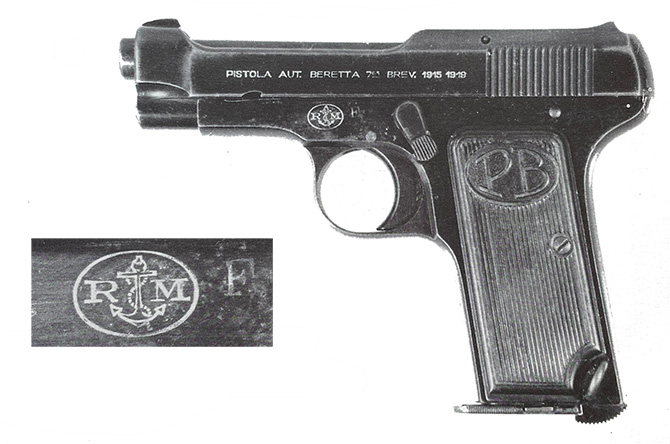
| The Italian Royal Navy bought a several hundred Model 22 pistols, punch marking them with its symbol on both sides of the frame. Note the magazine release catch of the 2nd type, which is rounder than that of the previous type. | |||
Although Model 1922 had not been officially accepted, a few hundred of them were sold to the Italian Royal Navy and to the Ministry of Military Aviation. This constituted the basis for the development of future Model 1931. |
|||
|
|||
The picture of pistol disassembled shows the principal components |
|||
General specifications
|
|||
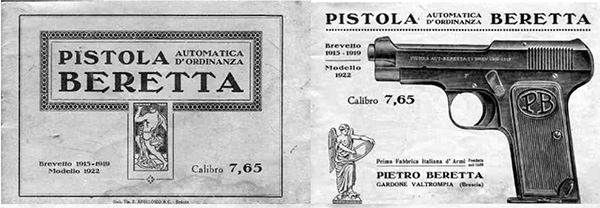 |
Original digital Owner Manual it is available |
||
|
The copy of this page is coming from a highly informative, comprehensive study of Beretta pistols. A book for collectors and enthusiasts. EDITORIALE OLIMPIA |
||
Beretta Web - Beretta Pistol 1922 .32 ACP


Beretta 92 History
| Beretta 92 DeLuxe
| Beretta Billenium
| Beretta 90-TWO
| Beretta 92
| Beretta 92S
| Beretta 92SB
Beretta 93R
| Beretta Target
| Beretta 92 Combat
| Beretta 92 .22LR Kit
| Beretta 92A1
| Beretta Vertec Steel
| Beretta 92 Gost
Beretta 418
| Beretta 1931-1934
| Beretta 1934
| Beretta 70 series
| Beretta 90
| Beretta 950
| Beretta 9000
Beretta 80 Series
| Beretta 86
| Beretta 89
| Beretta U22
| Beretta 8000
| Beretta 51
| Beretta Olympic